Throwback rumor: Randy Johnson to Indians in 1998
Back in 1998, the Indians were "a few minutes" from trading for Randy Johnson (instead of the Astros). What if this happened?

Throwback Rumors: Cano for Holliday | Peavy to Atlanta | Pujols to Cubs | Yanks pass on Miggy
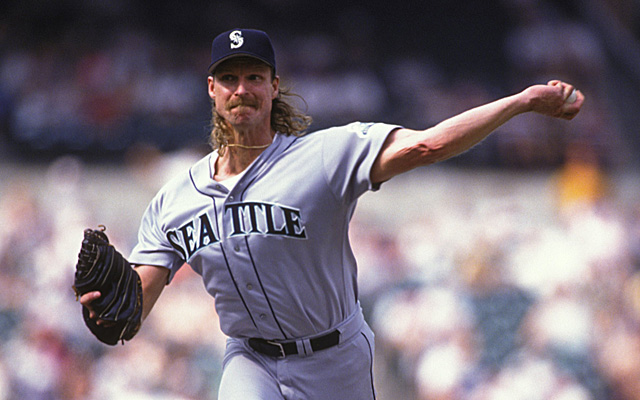
For our latest installment in the sometimes-fun-but-always-intriguing Throwback Rumor series, let's check out a certain left-hander who was equipped with baseball's most effective mullet. We'll get in our DeLorean and go back about 15 1/2 years to the summer of 1998.
Cy Young winner and four-time All-Star Randy Johnson was being dangled by the Seattle Mariners and the suitors were obviously aplenty. We now know that the Big Unit was traded to the Astros for Freddy Garcia, Carlos Guillen and John Halama. Johnson would go 10-1 with a 1.28 ERA, 0.98 WHIP and 116 strikeouts in 11 starts for the Astros, helping to propel them to a 102-60 record and an easy NL Central title.
What if, however, the Mariners had accepted the Indians' generous offer? Here's an interesting nugget from then-Indians general manager John Hart, via a column in the Cleveland Plain Dealer this past summer:
Hart still regrets coming within a few minutes of adding Randy Johnson in 1998 in a deal with Seattle. He had an offer of at least five players on the table, including Dave Burba, Brian Giles and Richie Sexson. "I thought we had a deal," said Hart. "But two minutes left before the trade deadline, [Seattle General Manager] Woody Woodward called back and said they were trading him to Houston."
Now that's intriguing.
Johnson would go on to win four more Cy Young awards, but those came after he signed with the Diamondbacks following the 1998 season. He retired as a 300-game winner with 4,875 strikeouts, 10 All-Star trips and a World Series MVP.
The fallout
Needless to say, this is a very difficult subject to estimate -- but given that the Indians haven't won the World Series since 1948, we need to broach the subject.
The 1998 Indians beat the Red Sox in the ALDS before losing to the Yankees, four games to two, in the ALCS. We can't get into what games of the series Johnson would have started because there's no realistic way to predict such things, however, it's rather easy to see where there would have been a huge boost. With the series tied at two games apiece, the Indians sent Chad Ogea to the bump. The same Chad Ogea who had a 5.61 ERA and had only started nine games in the regular season. He gave up four earned runs on four hits and three walks in just 1 1/3 innings, taking the loss in the pivotal game. Even if Johnson didn't start that specific game, the Indians rotation would have been bolstered with him at the top. The playoff rotation would have been Johnson, Bartolo Colon, Dwight Gooden and either Jaret Wright or Charles Nagy (remember, Burba was part of the proposed trade to land Johnson).
We have no way of knowing if that would have been good enough to unseat the mighty Yankees -- remember, they went 114-48 that year -- but they would have had a much better shot with Big Unit at the top of the rotation.
As far as taking out Giles and Sexson? The two combined to go 1-for-18 in the ALCS and weren't everyday starters yet. Since the Indians won the AL Central by nine games, I'm pretty hard pressed to think adding Johnson at the expense of Giles, Sexson and Burba would have harmed the club in the least in 1998.
In fact, it's a shame this didn't happen from a certain point of view. We may well have seen the Indians topple one of the greatest regular-season teams of all-time, interrupting the Yankees dynasty and possibly even giving the Indians their first title in 50 years -- helping to erase the bitter memories of the 1997 World Series.
Then again, if the Indians were bounced anyway and then lost Johnson to free agency -- as they surely would have -- it would have been better that they didn't get the deal.
Considering the Astros won the NL Central by 13 games -- well, technically 12.5 after the Cubs won a one-game playoff over the Giants to take the wild card -- it's very unlikely Johnson's absence would have cost them the Central. And considering the Astros were then bounced in the first round of the playoffs, it's actually very realistic to say this deal hurt them in the long run. They gave up several years of production from Guillen and Garcia for, essentially (and unbelievably), nothing of real substance aside from 11 fun regular-season starts by Johnson.
Seattle Mariners
In a vacuum, the Mariners' package for Johnson may have been better had they accepted the Indians deal. Guillen was a very good player, but his better years came after he was with the Tigers. He wasn't bad for the Mariners, but he wasn't much better than an average everyday player. Garcia was a two-time All-Star in the rotation and a very valuable starter for them for the better part of five seasons. Halama had a very good season in 1999, too.
However, here is the average season for Brian Giles from 1999-2002: .309/.426/.604 (160 OPS+), 36 doubles, 37 homers, 109 RBI, 108 runs and 10 stolen bases. He was one of the more valuable players in baseball during that stretch. I'm always partial to favoring which package of players had the best single player, so I'd have rather had the Indians offer.
That being said, this wasn't made in a vacuum. The Mariners at the time had Ken Griffey Jr. and Jay Buhner on the outfield -- not to mention Edgar Martinez at DH -- and badly needed pitching help, especially to soften the blow from losing Johnson. Garcia and Halama is a much better pitching return than Burba and spare parts. Plus, we know that the Mariners made the playoffs in 2000 and 2001 -- when they went 116-46 -- with the help of Garcia and Guillen.
It's unlikely there was much of an impact here. The D-Backs still would have had the ability to outbid the Indians for the services of Johnson. The motivation wouldn't have been any different here.
Deeper layers ...
Some more things to ponder had the Indians deal been accepted instead of Houston's:
•Sexson was later dealt to the Brewers in a trade that sent Bob Wickman to Cleveland and Marco Scutaro to Milwaukee. Sexson was then traded to Arizona for Chris Capuano, Lyle Overbay, Jorge De La Rosa and more. If Sexson were in Seattle, though, none of this is possible.
•Giles was traded to the Pirates for Ricardo Rincon (of "Moneyball" fame!). Then, in 2003, Giles was traded to the Padres for Jason Bay and Oliver Perez. If Giles were in Seattle, though, none of this is possible. Think down the road at how Jason Bay went to the Red Sox when Manny Ramirez went to the Dodgers.
•Garcia was traded to the White Sox in 2004 for Mike Morse, Miguel Olivo and Jeremy Reed. Garcia was then part of the White Sox rotation when they won their first World Series since the Black Sox scandal. Garcia was then traded in 2006 to the Phillies for Gavin Floyd and Gio Gonzalez. So there's a huge ripple effect with Garcia, obviously.
In all, it really is amazing how many different organizations and players are affected with multi-player trades and this is just one of thousands of examples.